- Home
- Latest News
- Government
- South African Budget Deficit Problem – Municipal Edge
South African Budget Deficit Problem – Municipal Edge
South African Budget Deficit Problem – Municipal Edge
“I learned that South Africa has had a budget deficit since 1980 except for the 2007 and 2008 budget years.”
– Vela Mtshali CA(SA)
“Mr Vela Mtshali is a Chartered Accountant specialising in public sector accounting, auditing, and consulting. He shares this article as an extract from his academic paper at the University of Stellenbosch Business School. He has more than 22 years working experience as an auditor, executive, CFO and consultant for various public and private organisations.” – Municipal Edge
During the Public Sector Finance module of the Master’s in Development Finance at the University of Stellenbosch Business School, we were given an interesting case study/assignment. which was to identify a country that has had a budget deficit for the past 5 years. The purpose of the study was to identify root causes and advise the Minister of Finance on the solution to overcome the budget deficit problem.
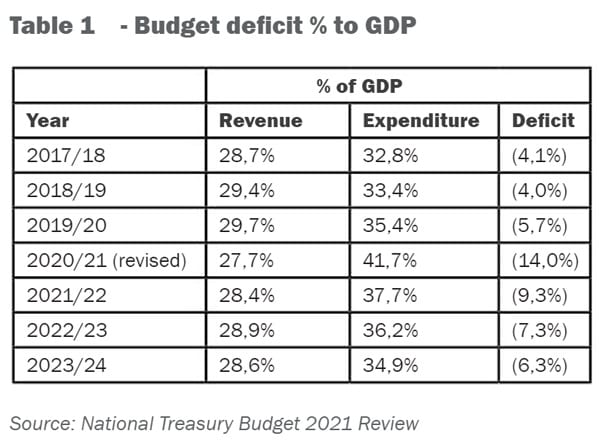
As a proudly South African citizen, interest is always to learn about my country. The first step was to check if South Africa qualifies to be used as a case study. The answer was a big YES. Table 1 below will unpack further why South Africa qualifies.
What I found shocking was that the budget deficit at the time was R370 billion (6.8% of GDP) according to budget 2020/21, the pre-Covid 19 budget. As former CFO in the public sector, I have never dealt with the country budget, my experience is limited to provincial budgeting and municipal budgeting. The budget deficit can be defined as when the budget does not have enough revenue to cover expenditure, therefore debt is used to close the gap.
The Current State of South Africa’s Budget Deficit
The Minister of Finance,Mr Tito Mboweni, revised the budget deficit estimate for the budget 2020/21 from R370 billion to R689 billion which equates to 14% of GDP. The impact and pressure placed on government spending by the Covid-19 pandemic are reflected in these numbers. The budgeted deficit for the 2021/22 financial year is R5OO billion which equates to 9.3% of GDP. Before Covid, the National Treasury attributed the increase in the budget deficit to low economic growth and increased support to state-owned companies.
A debate continues whether the lack of balancing the budget is the result of poor governance or simply due to the magnitude of economic problems that the government seeks to alleviate. Whatever the cause, the debt used to cover the gap between revenue and expenditure is a growing problem and means that future generations will be bearing the burden of debt for years to come.
South Africa’s debt service cost for the 2021/22 financial year is R269.7 billion compared to R229 billion in the previous year. The debt service cost is only exceeded by the total consolidated allocation to basic education. This is shocking! The National Treasury already noted in 2020 that the debt service costs were the fastest growing area of expenditure in the national budget. The country is now faced with a debt trap and this is not sustainable. The gross debt for South Africa has increased from 65.6% to 80.3% of GDP for the year 2020/21. This is an alarming level of debt.
The table below provides detailed history of the budget deficit, national expenditure and national revenue as a percentage of GDP. The schedule clearly shows how expenditure grew over the years, but the revenue side has declined. The revenue to GDP for 2020/21 decreased by 1% to date when compared to 2017/18 but expenditure increased by 8.9% for the same period. This could be a reflection of the state of the South African economy – the low economic growth.
While significant focus is being placed on reducing the expenditure over time, further attention must be placed on the revenue shortfall and growing the revenue envelope. Considering the pandemic, this is an incredibly difficult time to limit expenditure when approximately R11 billion has to be set aside for free vaccine roll out.
The South African economy has not been doing well, even before Covid-19. The unemployment rate was high and the economy failed to sustain growth, nothing new. To reduce the national budget deficit over the MTEF (Medium Term Expenditure Framework) is urgent, targeted, and the necessary steps must be taken.
We cannot just talk about zero-based budgeting; we need clear strategies and public policy to grow revenue and ensure value for money on the expenditure side. There is an empirical study that has concluded that the economic determinants of the budget deficit include macroeconomic problems, high unemployment rate, poor economic growth, and high government investment expenditure, sounds familiar for South Africa?
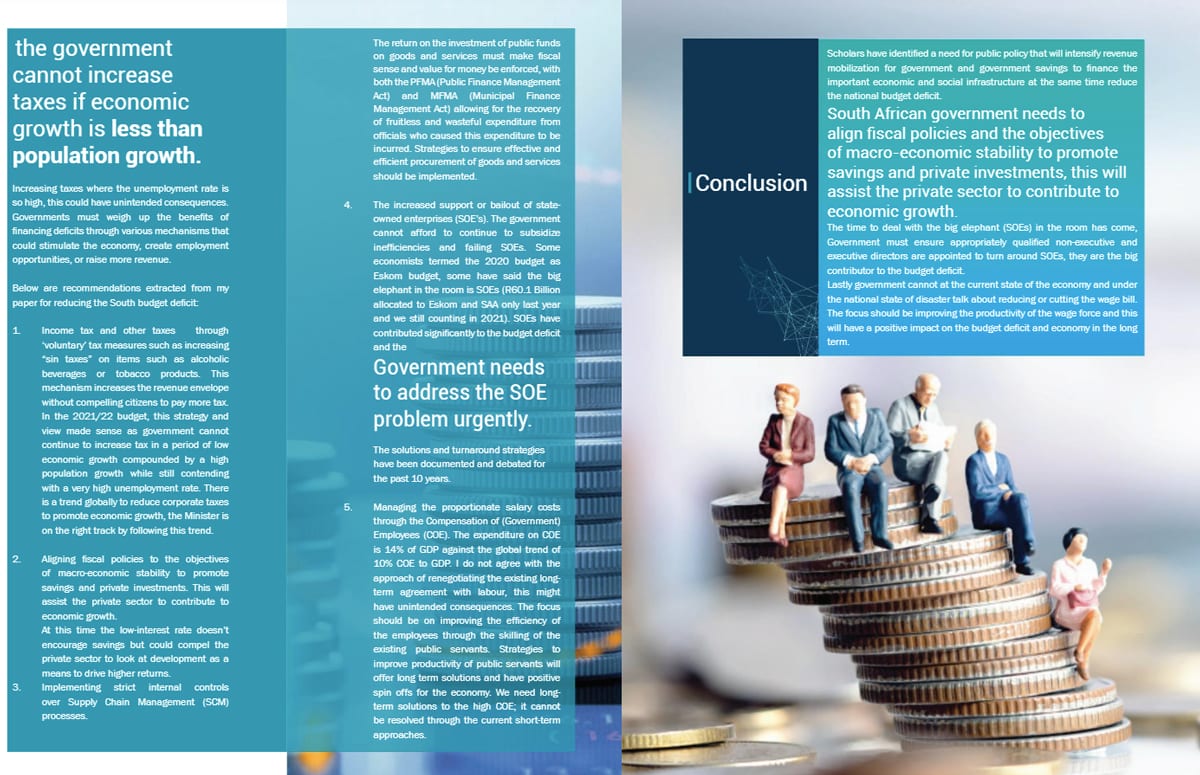
Options available to reduce the budget deficit; the obvious solution to the budget deficit is to either increase revenue or decrease spending, or a bit of both. Considering the current economic and pandemic climate, the focus for 2021/22 is on cutting spending in areas that do not create many jobs. The major source of revenue for the government is taxes but according to economists, the government cannot increase taxes if economic growth is less than population growth.